 Enlarge
 中文
Enlarge
中文
Enlarge
Since Autumn 2018
I first travelled to Mongolia in September 2018. Its vast landscapes, rich history and deeply rooted traditions left a lasting impression on me. After returning home, I wrote about the journey and was invited to speak about Mongolia on several occasions, including an interview with Malaysian radio station AiFM.
What follows is an edited transcript of that conversation.
When did you first travel to Mongolia?
I first visited Mongolia in late September 2018. Autumn was an ideal time to go: the weather was fairly settled and the landscape was full of colour. The journey lasted about two weeks.
I returned in March 2019 to photograph the reindeer-herding communities in northern Mongolia. Although it was already March, winter still held the region firmly in its grip, and the cold was severe. I stayed for almost two weeks on that occasion as well.
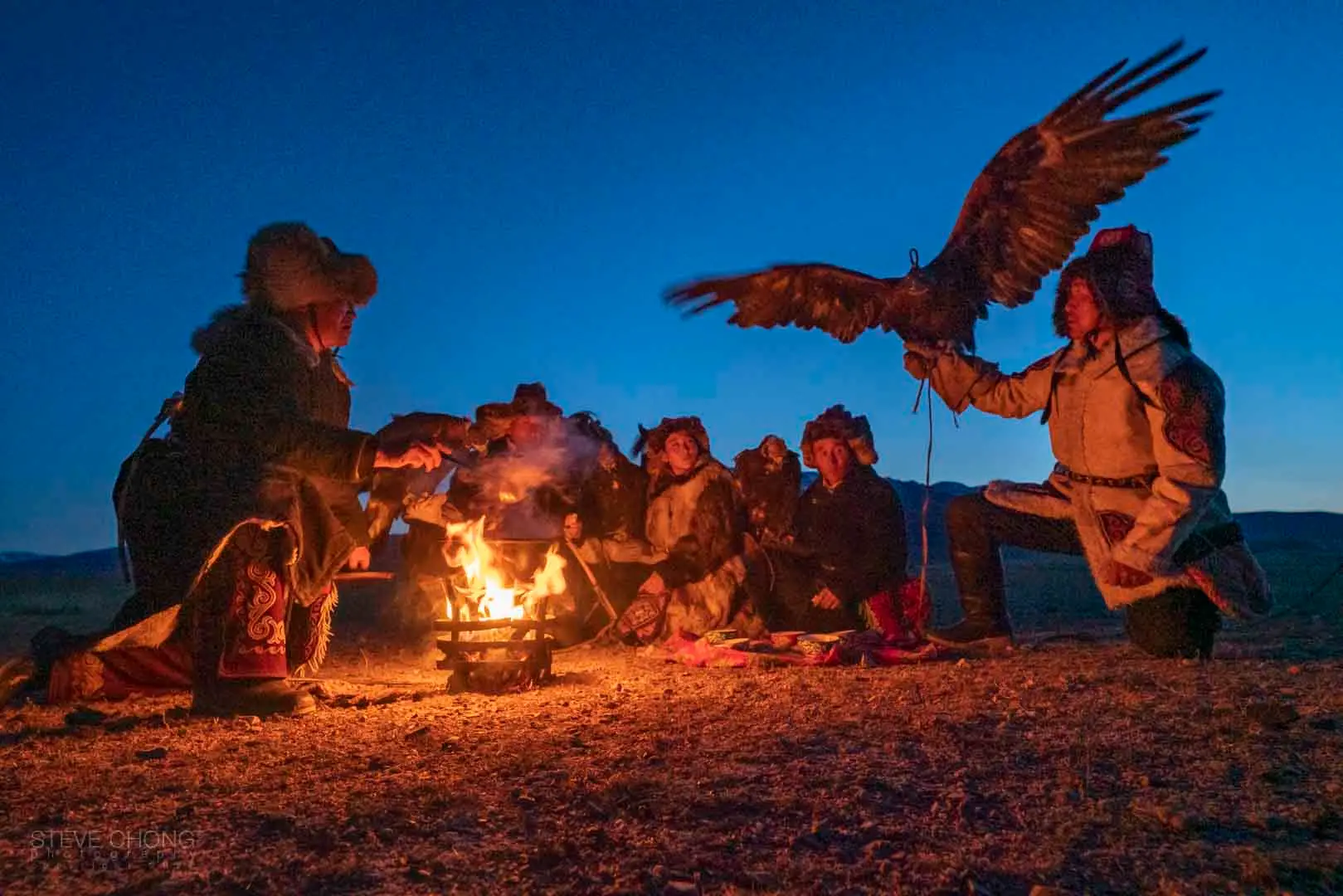
My next visit came towards the end of 2019, when I returned to photograph the Eagle Hunters.
What drew you to Mongolia?
Mongolian history had fascinated me since childhood. I read about figures such as Genghis Khan and Kublai Khan, and the scale of the Mongol Empire captured my imagination.
Years later, I watched the film The Eagle Huntress and learned more about Mongolia's Eagle Hunters. I also discovered that one of the world's few remaining reindeer-herding communities lived in the north of the country. Mongolia seemed to possess a culture unlike anywhere else, and I felt compelled to experience it for myself.
From a photographic point of view, it also offered an extraordinary range of subjects, from people and traditional ways of life to vast, open landscapes.
Which places did you visit?
My first journey centred on the Eagle Hunters and the Golden Eagle Festival. The festival was held in Bayan-Ölgii, around 1,277 kilometres from Ulaanbaatar.
We also travelled deep into the Altai Mountains, where we saw petroglyphs believed to be about two thousand years old. We stayed in yurts, rode horses through the surrounding country and spent time among snow-covered mountains. It was an unforgettable experience.
Naturally, we also visited an Eagle Hunter and his family.
Finding the Eagle Hunters was not especially difficult because our local guide had arranged the visit in advance. They lived outside the town, and reaching them required an early start.
As photographers, we wanted to work with the first light, so we left at around three in the morning and reached the family's home before sunrise. Despite the hour and the cold, the Eagle Hunters were already outside waiting to welcome us.
Once we had settled in, we began photographing. We worked almost continuously from dawn until dusk.
How did you reach the Golden Eagle Festival grounds?
The festival grounds were just outside Bayan-Ölgii, about a forty-minute drive from our hotel. Part of the competition took place near a hill, which provided the height needed for several of the eagle events.
What makes the Golden Eagle Festival so interesting?
The annual festival brings together many traditions associated with the Eagle Hunters' way of life.
One event involved a fox skin placed as a target. A companion of the Eagle Hunter climbed the hill with the eagle. At a signal from the hunter below, the bird was released. It took flight, responded to its master's call, located the target and swooped down upon it.
The judges considered several factors, including speed, distance and the eagle's approach. For photographers, the event offered remarkable action and movement.
Buzkashi was equally exciting. Two riders struggled for possession of a sheep while remaining on horseback. It was a powerful display of strength, balance and horsemanship.
During the 2018 festival, we were fortunate to meet the sister of Aisholpan, the young Eagle Huntress featured in the film.
The festival attracted visitors and photographers from across the world, including Europe, the United States, Asia and Australia.
Were there any experiences you found especially memorable?
There were many.
One was riding through the snow-covered mountains. I am not an accomplished horseman, but during that journey I learned to control the horse well enough to ride without assistance. Moving through that landscape on horseback was something I will always remember.
Another was witnessing an eagle pursue a fox. A senior Eagle Hunter wanted to show us how the birds hunted, so we went to an open area surrounded by hills.
When the fox was released, it immediately ran for its life. The Eagle Hunter then released the eagle. The moment the bird saw the fox, it folded into a steep dive, almost like a bomber, and seized it in its talons.
The hunter galloped over, dismounted and carefully freed the fox from the eagle's grip. Seeing the entire sequence unfold in front of us was unlike anything I had experienced before.
And then there was our stay in the yurts.
We spent several nights in yurts in the Altai Mountains. They ranged from very simple shelters to luxurious versions with toilets and heaters. Some were comfortable enough to rival a good hotel.
Mine, however, had no stars at all. It was back to basics.
There was a stove in the centre and a simple carpet on the floor. That was all we had for warmth. Unfortunately, part of the opening at the top of the yurt had not been properly covered, and the night wind blew directly towards me.
To make matters worse, the fire in the stove went out. Even beneath a thick quilt, I could not get warm. The temperature was below freezing, and my nose felt as though it might turn to ice.
Eventually, I climbed out of bed, found some firewood and relit the stove. Before long, warmth returned to the yurt and I managed to sleep through the rest of the night.
For someone who has spent almost his entire life in a tropical climate, it was certainly a night to remember.
How would you describe the life of the Eagle Hunters?
Their way of life is simple and closely tied to the land.
In the past, families had to provide much of what they needed themselves, and training eagles to help with hunting was both practical and ingenious. Today, food and daily necessities are easier to obtain, so the need for eagle hunting has diminished.
As a result, the skill is becoming increasingly rare. I was told that fewer than fifty people still possessed the knowledge required to train a hunting eagle. Unless it is passed to the next generation, there is a real danger that the tradition may disappear.
I hope younger Eagle Hunters will continue to learn and preserve it.
Is there a philosophy behind the Eagle Hunters' relationship with their birds?
The Eagle Hunters have a profound respect for nature.
They train and hunt with an eagle for several years, often four or five, before releasing it back into the wild. By then, hunter and bird have lived and worked together long enough to form a deep bond.
Letting the eagle go cannot be easy, yet they do it because they believe that what has been taken from nature must eventually be returned.
Some released eagles are said to revisit the area around their former hunter's home, almost as though returning to see an old friend. A few have reportedly appeared again more than a year after their release.
That says a great deal about the extraordinary bond between the Eagle Hunters and their birds.